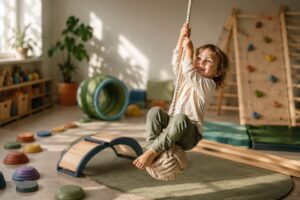
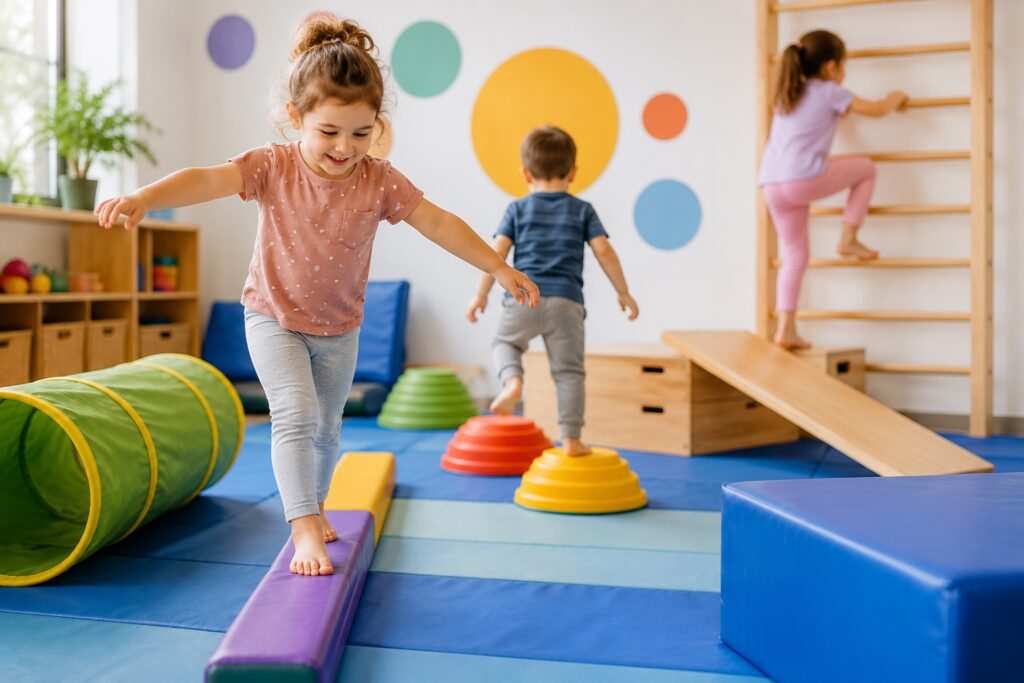
Psychomotor development does not require expensive equipment or a specially designed room. Many valuable movement experiences can be created at home using cushions, blankets, boxes, chairs and other everyday objects.
The central idea of Psychomotorik is not to train children through strict exercises. It is to create opportunities for exploration, creativity and independent problem-solving.
Build a Movement Course
A simple movement course can be created with objects that are already available at home.
Children can:
- climb over cushions
- crawl under a table
- balance along a line made from tape
- jump between pieces of paper
- step into boxes
- move around chairs
Allow the child to help design the course. Planning and rebuilding it can be just as valuable as completing it.
Adults should check that the environment is safe, but they do not need to explain every step. Children often develop creative solutions when they are given enough freedom.
Play with Blankets and Cushions
Blankets and cushions can be used in many different ways. Children can build caves, create soft mountains, wrap themselves up or transport objects from one place to another.
These activities support body awareness, coordination and spatial perception. Building together can also encourage communication and cooperation.
A blanket may become a boat, a roof, a tunnel or a secret hiding place. There is no need to define the correct way to use it.
Explore Balance
Balance can be practised with very simple activities. Place a rope, scarf or strip of tape on the floor and invite the child to walk along it.
The child can try moving:
- forwards
- backwards
- sideways
- slowly
- while carrying an object
- with closed eyes and adult support
The activity can be adjusted to the child’s confidence and ability.
Transport, Push and Pull
Children often enjoy moving heavy or bulky objects. They can push a box filled with soft toys, pull a basket with a rope or carry cushions across the room.
These activities provide strong sensory feedback and allow children to experience their own strength. They can also support planning and problem-solving.
Make sure that the objects are safe and not too heavy.
Follow the Child’s Ideas
Adults often feel that an activity needs a clear goal. In psychomotor play, the child’s own ideas are particularly important.
A planned obstacle course may suddenly become a zoo, a spaceship or a rescue mission. This is not a distraction from the activity. Imaginative play adds emotional, cognitive and social dimensions to movement.
The adult’s role is to provide time, space and appropriate materials.
Focus on Experience, Not Performance
Avoid correcting every movement or comparing siblings. A child does not need to perform an activity perfectly for it to be valuable.
Simple questions can encourage reflection:
- How did that feel?
- Was it easy or difficult?
- Do you have another idea?
- What would you like to change?
Psychomotorik at home can be playful and uncomplicated. The most important ingredients are movement, curiosity, safety and the freedom to explore.