Children discover the world through movement. They crawl, climb, jump, balance, touch, build and experiment. These activities may look like ordinary play, but they are essential parts of a child’s development.
Psychomotorik is a holistic educational approach that connects movement, perception, emotions, thinking and social interaction. It is based on the understanding that physical and psychological development cannot be separated. When children move, they do not only train their muscles. They also develop confidence, concentration, independence and social skills.
Learning Through the Body
Young children understand many concepts through physical experience. They learn what “high,” “low,” “fast,” “slow,” “heavy” or “light” means by experiencing these qualities with their bodies.
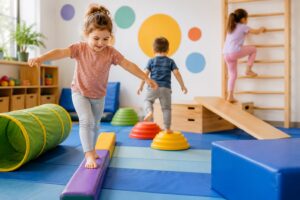
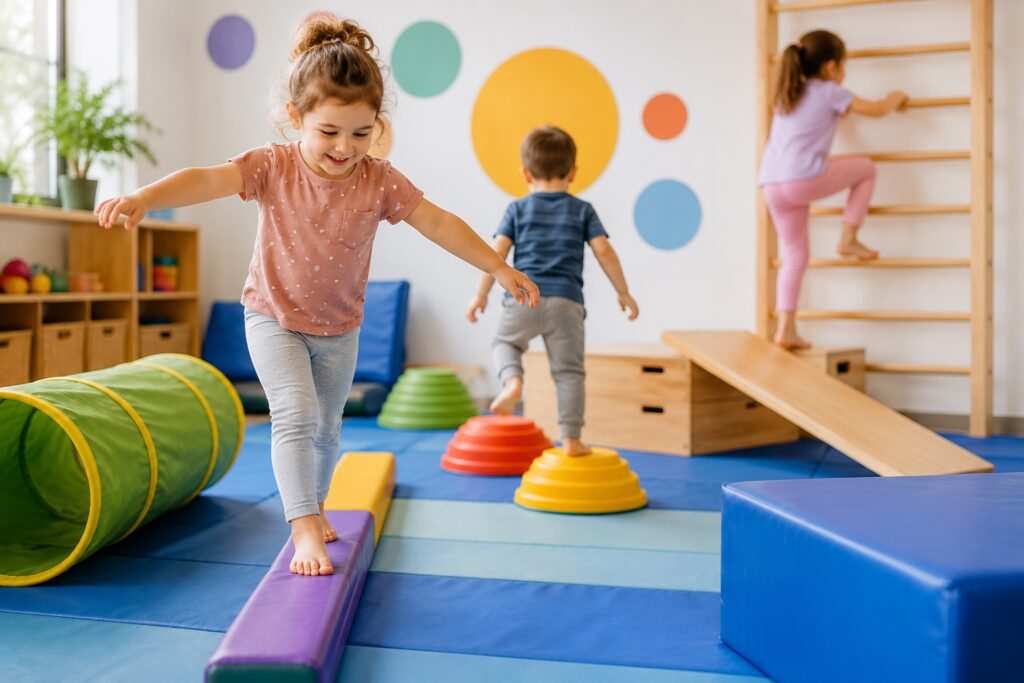
A child balancing on a beam, for example, practises much more than balance. The child must concentrate, assess risks, control movements and manage uncertainty. Successfully completing the task can create a strong sense of achievement.
These experiences help children build trust in their own abilities.
Movement and Self-Confidence
Psychomotor activities are usually open-ended. There is not always one correct solution. Children can explore equipment and materials according to their own abilities and ideas.
One child may crawl under a bench, while another balances across it. Both solutions can be valuable. This gives children the opportunity to make decisions and experience themselves as capable and effective.
The goal is not perfect performance. The goal is to encourage children to try, explore and develop their own solutions.
Supporting the Whole Child
Psychomotorik can support several areas of development:
- gross and fine motor skills
- body awareness
- balance and coordination
- concentration and perception
- emotional regulation
- confidence and independence
- communication and cooperation
Because every child develops differently, activities can be adapted to individual needs. Children can participate at their own pace without constant comparison.
Creating Space for Exploration
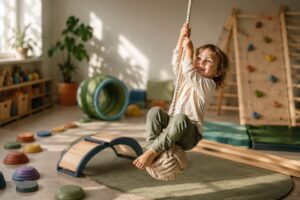
Children need safe spaces where they are allowed to experiment. Climbing equipment, cushions, ropes, balls, boxes and everyday materials can encourage creative movement.
Adults provide a secure framework, observe the children and offer support when necessary. At the same time, they leave enough freedom for children to develop their own ideas.
Psychomotorik therefore does not simply teach children how to move. It helps them understand themselves, interact with others and approach new challenges with confidence.